Everything on this site, explained plainly.
Two memecoin armies fight a 3D war that never ends. Every real trade fires a shot. You can watch it for free, and you can put your own name on the battlefield for free — no wallet, no account, no email. This page walks through all of it.
ON THIS PAGE
01Just watching
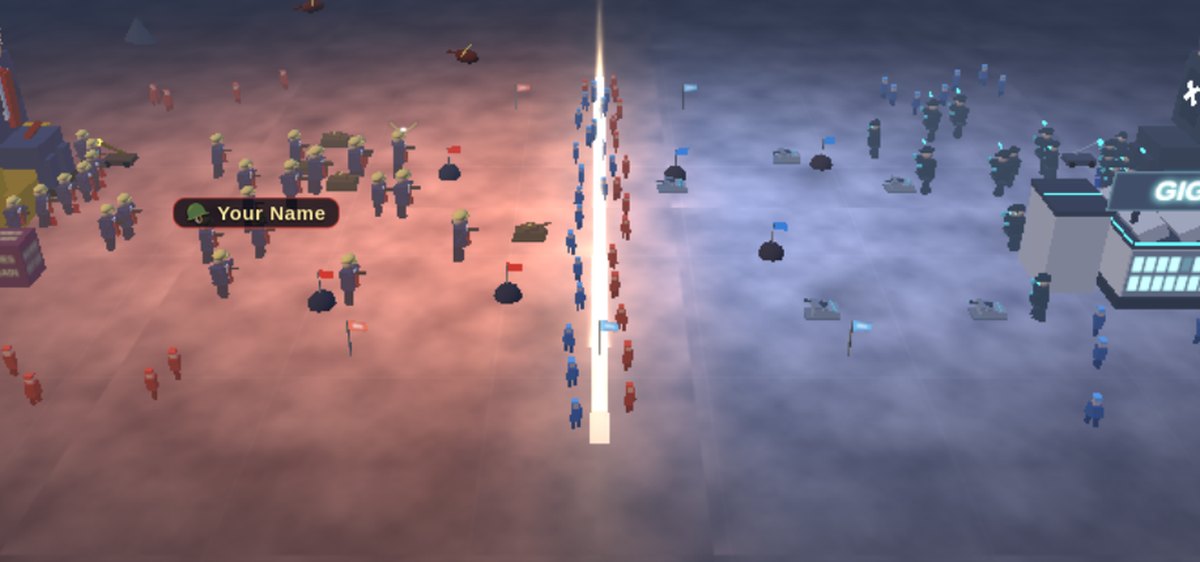
Open the battlefield and it runs. There is nothing to sign up for and nothing to install. Red is $TRUMP, blue is $MUSK, and the line between them moves as the two coins trade against each other.
If you would rather not have a tab open, the same war is broadcasting around the clock on X. It is the identical battlefield, rendered on a server that never closes the tab.
02What the numbers mean
Everything on the scoreboard comes from real market data. None of it is invented, and when the data stops arriving the site says so rather than making something up.
Battle power
The big number for each side, out of 100. It is worked out from real trading — buy pressure, volume and market cap movement — and it decides where the front line sits. Nothing else on this site can move it. Enlisting does not move it. Recruiting people does not move it. It is trades, and only trades.
Holders under arms
How many wallets hold that coin. One holder is drawn as one figure in the crowd behind the front line, so a side gaining holders visibly fills out.
Price, market cap, 24h volume
Straight from the chain and the market, refreshed continuously. The contract address for each coin is on screen so you can check any of it yourself.
The reconnecting badge
If the live feed drops, a badge appears and the numbers freeze at the last real values. The battlefield does not invent movement to fill the gap. No badge means the data is live.
03What the two of them are saying
The bosses are not decoration. They react to what is actually happening on the chart — a whale buying, a lead changing hands, a long quiet stretch, a collapse — and they have 778 lines between them to do it with.
Nothing repeats for a long time. The picker always chooses whichever line has gone unheard the longest, and it remembers across visits, so coming back tomorrow does not restart the same handful of jokes you heard today.
They answer each other
Some of it is written as an exchange. One of them says something, and about three seconds later the other one replies to that specific line. Once the setup has been said the reply is guaranteed — you will never get half of a joke.
The midterms are coming
They are both counting down to 3 November 2026, and they bring it up more often the closer it gets. After it passes they stop — nothing here will still be counting down to a date that has already happened.
They talk over the battle, not through it. When a lot is happening the bosses give way to the play-by-play, and the trash talk fills the quiet stretches — which, on a low-volume day, is most of them.
04The cities they are building
When the chart goes quiet, the war does not stop — it changes jobs. After two minutes without an eligible trade, work brigades walk off the front line and build: streets first, then lights, then buildings, following a master plan of roughly a hundred structures per side. The moment a trade lands, everyone drops their tools and sprints back to the fight. Every structure you see went up this way, in real time, on the broadcast.
The money is real, and one conversion is not. Each city is paid for from its founder's real net worth — the figures on the counters are sourced and dated on screen. But real trading volume and real net worth are seven orders of magnitude apart, so the game uses one disclosed exchange rate: $1 of real on-chain volume becomes $1,000,000 of city capital. That is a game conversion, printed here so nobody mistakes it for real money. The true, unconverted trading figures are always shown separately.
The debt clock is the joke, and it is honest. Both cities cost exactly the same. One founder can afford that and one cannot, so one treasury goes publicly negative and keeps building anyway — and only real trading volume pays the debt down. Attacks are real too: a big enough buy scars the far side's building nearest the front line — the front row falls first, deeper rows only once the row ahead is rubble — and repairs jump the construction queue.
05Putting your name on the field
Enlisting takes about five seconds and costs nothing. You get a soldier carrying your name who marches, fights, gets killed in the big moments and comes back.
- Open the battlefield and press ENLIST in the toolbar.
- Type the name you want over your soldier's head. Two to sixteen characters.
- Pick a side — TRUMP ARMY or MUSK ARMY.
- That is it. Your soldier walks on, and everybody watching sees him — including the 24/7 broadcast.
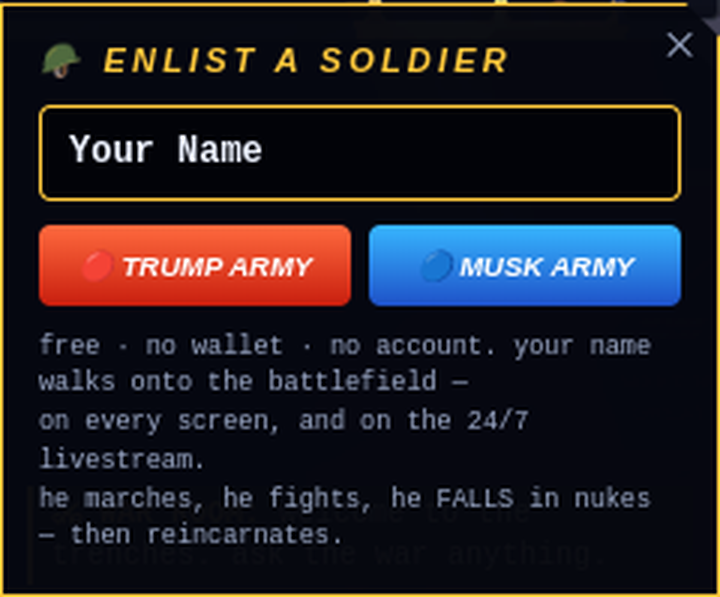
Your browser remembers your soldier, so you keep him when you come back. Enlisting again with a different name renames the soldier you already have rather than creating a second one.
06Your soldier's link
When you enlist you get a permanent address for your soldier, like trumpvsmusk.fun/s/AB12CD. It is in the enlist panel with a copy button. That link is the entire account system — there is no password to lose and nothing to leak.
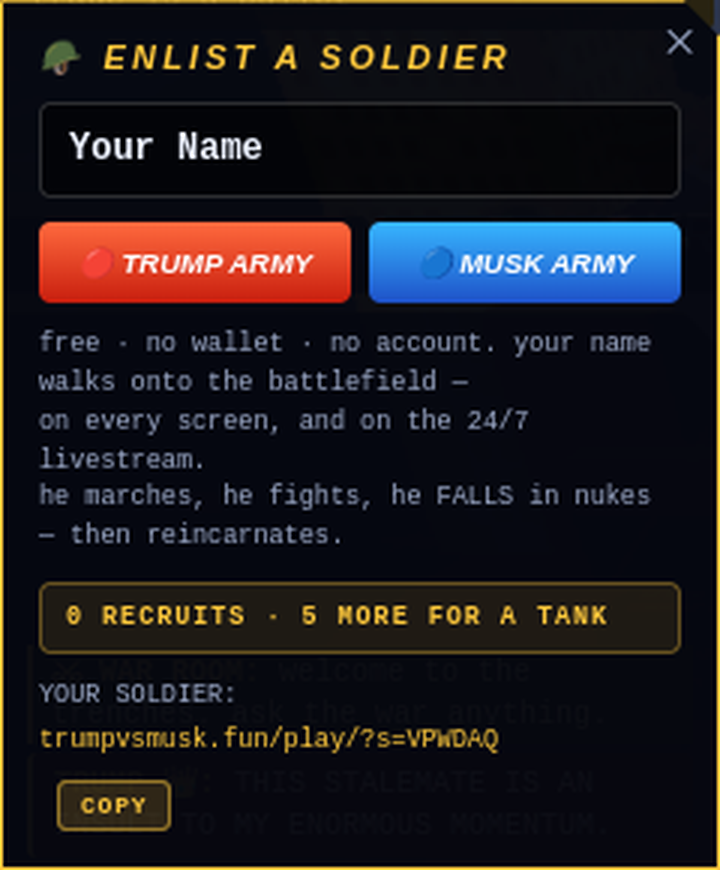
Post it anywhere and the preview carries your soldier's name rather than a generic site card, because the page behind it is built for that one soldier.
07Finding your soldier
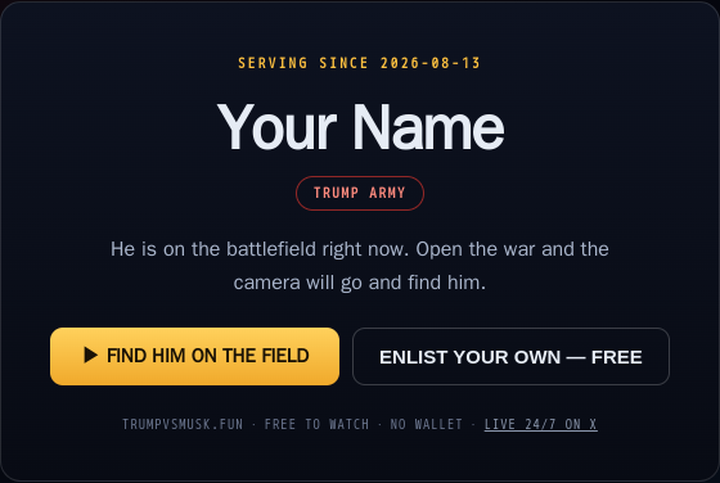
There are hundreds of figures out there, so following a soldier link does the work for you: the camera goes and finds that soldier, marks him in gold for about nine seconds, and then hands control straight back.
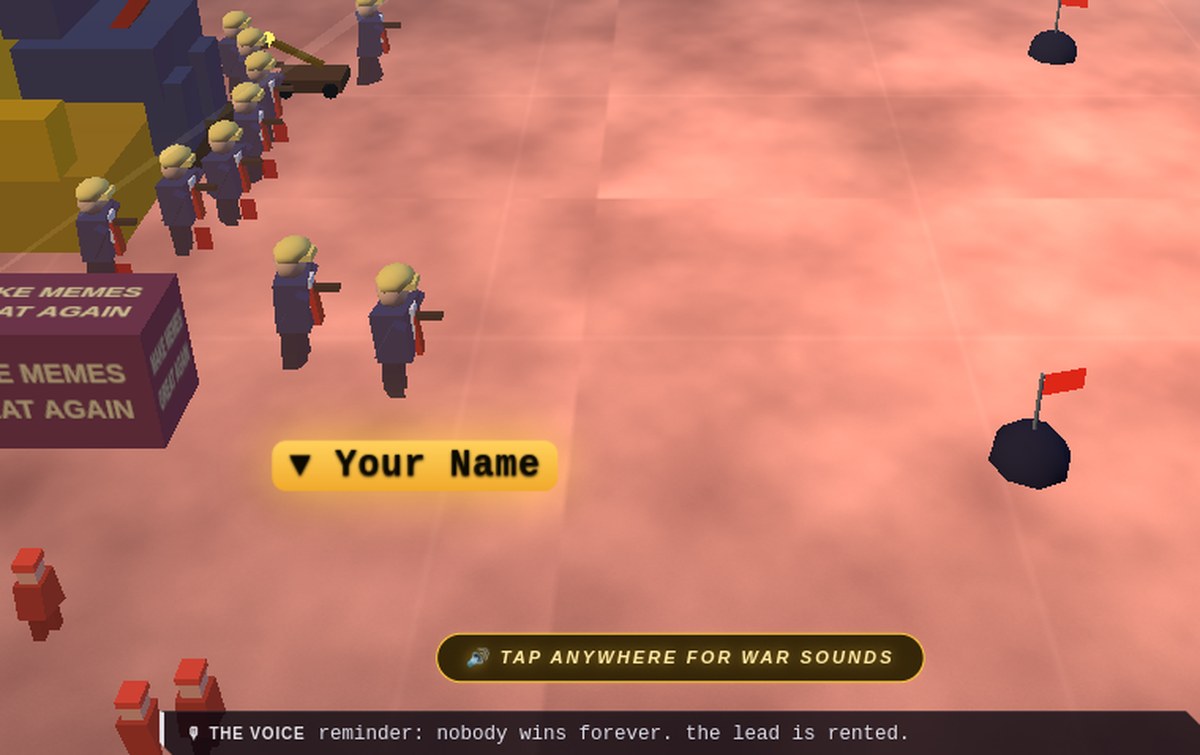
If that soldier is not on the field at that moment, the war feed says so after twenty seconds. It will never point at some other soldier and pretend.
08Ranks, and how to earn them
When somebody enlists through your link, you get the credit. Bring enough people in and your soldier is promoted on the battlefield.
- 5 recruits — your soldier gets a tank, with your name on it.
- 20 recruits — the announcer reads your name out over the battlefield.
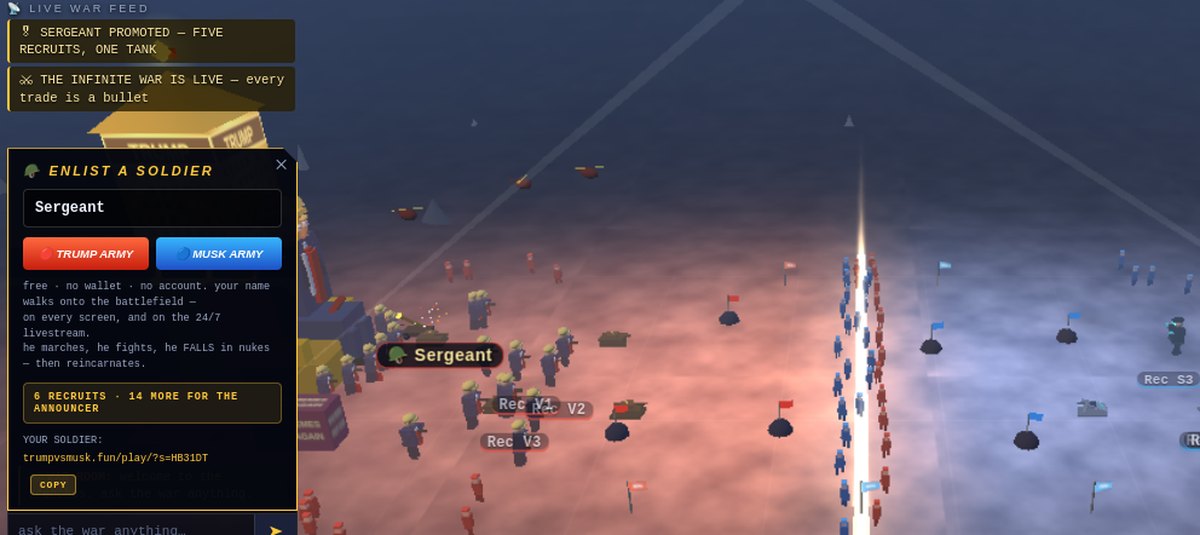
Every recruiter is listed on the roster, which is public and updates as people join.
The anti-cheating is deliberately light: you cannot credit yourself, and one browser cannot credit the same person twice. Beyond that we would rather under-count a real recruit than turn a bit of fun into an identity check.
09What we store about you
Close to nothing, and it is worth being specific about it.
What is kept
The name you chose, which army you picked, the date, and your soldier's code. That is the whole record.
What is not
No account, no password, no email, no wallet address. Your IP address is never written to disk — it is used in memory to limit how many enlistments an hour can come from one place, and that is all.
Your browser keeps your soldier's code so you keep him between visits. Clearing your browser data loses that link to him — so if you want to keep your soldier, keep the link.
10Questions
- Do I need to own either coin?
- No. Watching and enlisting are both free and neither requires a wallet. Holding a coin does not enlist you either — they are separate things.
- Does enlisting help my side win?
- No, and it never will. Battle power comes from real trading only. Enlisting adds a soldier carrying your name; it does not move the front line.
- Can I change my name or switch sides?
- Yes. Enlist again with the new name or the other army and your existing soldier changes. You keep the same link.
- My soldier died. Is he gone?
- No. Soldiers are killed in the big moments and come back shortly after. If it was your own soldier you also get a shareable card naming what killed him, carrying his link.
- I do not see my soldier.
- The battlefield carries a capped number of named soldiers at once, newest first, so during a rush an older recruit may be standing down. Open your own link and the camera will go and find him if he is out there.
- Is this financial advice, or an investment?
- No. It is a visualisation of two memecoins fighting, built for fun. Nothing here is advice, and nothing here should be read as a reason to buy anything.
- Is any of it fake?
- The market data is not. Prices, volume, market cap, holders and battle power come from the chain and the market, and when the feed drops the site tells you instead of inventing movement. The soldiers, the tanks and the taunts are obviously a cartoon.